Thursday, January 9, 2020

Air-to-air offence capability: Iran vs USA


World War 3 is trending these days. The relations escalated very quickly, especially after the assasination of Qassem Soleimani, Islamic Revolutionary Guards' general (now former general). Missiles are being fired from both sides with targets on importamt strategic assests and statements flooded the social media. Instead of a regional conflict, chances of all-out global war are quite high. Considering the fact that many countries have their interests in Iran due to presence of rich oil fields in the region. And the war between two countries affects the world trade. So at this time most of the countries want de-escalation as soon as possible.

Aerial Warfare is always a favourable choice in 5th generation warfare. It assures high damage to enemy with low risk of friendly casualities. The recent US airstrike against Soleimani supports the fact. Instead of sending Special Forces, United Staes preffered drone strike to hit the intended target. However, there are still certain cases where ground forces can do the job much effectively than the Air Force. Anyway,  Without wasting any more time, let's start our analysis on aerial warfare capabilities of both countries. Please note that in this analysis, US Navy and Marine Corps are excluded.

Air Dominance Fighter 


United States Air Force

Lockheed Martin F-22A "Raptor"


Even after 15 years, the F-22 is still a capable 5th generation fighter proudly serving for it's sole operator, United States Air Force. Thanks to regular upgrades, thereis still no match for F-22 in this world and the aircraft is purely designed for air superiority. With the AN/APG-77 Active Electronically Scanned Array (AESA) radar gives it a long range detection & tracking capability. The actual range is still classified but it is estimated to be somewhere around 200km against airborne targets with least Radar Cross Section (RCS).

Units in service:- 160+

Boeing F-15C "Eagle"


An aircraft that is developed to take on Soviet Flankers. The aircraft is truly a beast in the skies with the capability of knocking bandits at beyond visual ranges with it's AN/APG-63(v)2 AESA radar coupled with AMRAAM.


Units in service:- 200+


Iranian Air Force

Grumman F-14A "Tomcat"


Acquired in 1976 when there were friendly relations between these two countries, sadly now they are enemies. There were various reasons for this purchase. First was the requirement of an interceptor aircraft for Imperial Iranian Air Force (later renamed as Islamic Republic of Iran Air Force), second was ineffectiveness of Iranian ground based radars as there were various blind spots, allowing Soviet fighters to successfully conduct reconnaissance missions over the territory and return back. This was a concern for the Iranian military that forced them to acquire a fast inteceptor and hence they approached for F-14 "Tomcat", but that only provided them a fast interception of enemy bogies but also it acted as a forward air controller during Iran-Iraq War missions to ensure safe passage for strike group. It was also an effective air suuperiority fighter. Thanks to the AWG-9 X-band pulse doppler radar allows it to track airborne targets within 160 kms.

Units in service:- 50+ (uncomfirmed)

Multirole Fighter/Medium Weight Fighter


United States Air Force


Lockheed Martin F-35 "Lightning II"


Unlike the F-22, this aircraft is in service with various operators around the world. Developed by contribution of United Kingdom, Italy, Netherlands, Denmark, Australia, Norway and Turkey (now kicked out) under the "Joint Strike Fighter" program. The aircraft features AN/APG-81 Active Electronically Scanned Array (AESA) radar with 150km range for 1m2 RCS targets. It can track 23 airborne targets in 9 seconds and engage 19 of them within 2.4 seconds. It has multiple modes that also includes air-to-ground mode with high resolution mapping, multiple ground moving target indication and track, combat identification, and electronic warfare capability. The aircraft is perfect for multirole operations with complete ability to conduct effective bombing role as well as safeguarding the skies.

Elctronic warfare is one of the distinct features of F-35. It enhances the survivability of the aircraft in intense combat zone. A recent news report claims that Israel Air Force F-35 succesfully managed to evade Russian radars during sorties over Syria, proving how sophisticated is the EW ability of the aircraft that jammed the highly advanced Russian radars. Isareli F-35I "Adir" is also referred as the most advanced F-35 variant.

Units in service:- 200+

Lockheed Martin F-16C/D "Fighting Falcon"


One of the world's favourite fighter aircraft. It is not only a capable machine but also the backbone of US Air Force due to abundant numbers. The fighter incorporates highly advanced avionics, precise armament and state-of-the-art electronic warfare capability with AIDEWS (Advanced Integrated  Defensive Electronic Warfare Suite) obtained after upgrades. Since 1991, F-16 took part in numerous combat missions with US Air Force and conducted various successful missions. The AN/APG 68 Pulse Doppler radar is compatible enough to detect targets within 250km range.

Units in service:- 650+

Iranian Air Force

Mikoyan Gurevich MiG-29 "Fulcrum"


Highly capable platform with good quality armament package. The MiG-29 boasts multirole ability, along with beyond visual range air-to-air engagement capability, like every other fighter in it's league. 2 types of variants (excluding trainers) are available, A and S. But the real field where MiG-29 may dominate over it's opponent is close range combat. The Infra-Red Search and Track (IRST) sensor allows the aircraft to maintain the tracking of the aircraft even in very close-combat dogfights.


Units in service:- 30 or more (unconfirmed)


McDonell Douglas F-4 "Phantom"


One of the greatest aircrafts in it's generation. Not truly a 4th generation but has the capability to knock out the opponent (an equivalent opponent) at 35-40km range with AIM-7 BVRAAM, that is compatible with it's AN/APQ-120 Fire-control radar.


Units in service:- 40+

Interceptor/Light Fighter


United States Air Force


-None-
Only trainers

Iranian Air Force

Chengdu F-7 "Airguard"


No expectations with the aircraft. Most of the units are grounded and not ready for combat. Only capable of within visual range combat with Chinese short range air-to-air missiles.

Units in service:- 10+

Northrop F-5 "Tiger"


A light combat aircraft and another fine example of US -Iran friendship in the past. This aircraft too, like the F-7, is incapable of firing beyond visual range missiles. AN/APQ-159 radar only allows a max detection range upto 37km only. Not a surprise as the aircraft is pretty old.

Units in service:- 25+ (unconfirmed)

Dassault Mirage F-1


After two disappointments, finally an aircraft that is capable of engaging aircraft at beyond visual range. But the missile package is unknown. Did you know thaf Iran never placed an order for the Mirage F1s. Actually, during the first Gulf War, coalition forces were dominating over Iraq. That forced Iraqi Air Force to surrender 24 of it's Mirages to Iran in order to save themselves from opposing bombers. Iran recieved these aircrafts as a "gift from Saddam". Earlier, there were difficulty in operating these jets but later, with some dirty work, Iran managed to gather enough supply parts to maintain them well. However, the current status is unknown with only 2 are rumoured to be in flyable condition.

Units in service:- 2 or more. (Unconfirmed)

As you notice that Iranian Air Force is flying with majority of aged fighters. And there is surely no match for modern American fighters which are highly upgraded with sophisticated modern technology. Also, as far as their indigenous fighters are concerned, like Azarkash, Saeqeh and Kowsar, experts believe that all are just showpieces without actual capabilities. So we excluded it from our list. But the article is not over yet. Now it is time for some weapon comparison. For air-to-air engagement, missiles are topmost priority in 5th generation warfare environment. So we are going to compare the armament of both fighter fleet:

R-27EA (Iran) and AIM-120C-7 (USA)


R-27EA is active with MiG-29 fleet. It is an active radar guided variant of R-27 with 9B-1103K active seeker. It is capable of achieving a soeed of Mach 4 and a range upto 125km. 

AIM-120C is primarily deployed on most of the USAF aircraft. The missile is highly effective under 110km range with a speed of Mach-4.

What makes AIM-120 better is it's comparatively smaller size than R-27EA, making it manuverable and gives it more range in look-down-shoot-down mode.


Fakour-90 (Iran) vs AIM-120 (USA)

IRIAF F-14 carrying AIM-54 (on which Fakour is based) under it's belly


When Iran recieved F-14s, the Air Force also recieved 200+ AIM-54 long range air-to-air missiles. And they used it extensively during Iran-Iraq war causing heavy damage to Iraqi Air Force. But the service life exhausted and forced Iran to look for an alternative. Sanctions didn't allow Iran to acquire more missile and they worked on the indigenous system with basic airframe of AIM-54. After working with the USSR, Iran developed their own BVRAAM and name it Fakour-90. The missile is right now installed on Iranian F-14s and the estimated range is somewhere around 220km, and a speed of Mach 5 with much better guidance than original AIM-54, that is active radar guidance independent of launch aircraft's radar. 


AIM-120D is probaly the best air-to-air missile in service with USAF. Right now deployed on F-22 and F-35 aircrafts. The range is not yet revealed but the estimations say it is somewhere around 145-150km. One thing that makes AIM-120D much better than Fakour is it's dual link feature. It allows cueing of the system with another friendly system, like an AWACS or fighter, that guides the missile towards the target, leaving the launch platform safe. It is usually preferred for extended range. Also an expanded No-Escape Zone (NEZ) assurs high kill rate against airborne targets. The best feature of AIM-120 missile is it's anti-jamming capability. During the course of moving towards the target, AIM-120 works in passive guidance and becomes active only 3-4 prior of impact, making nearly impossible for the bandit to evade (different result if the opponent is an experienced aviator). But it is an unpredictable case so technology wise, our winner here is AIM-120D.


R-73, PL-5, AIM-9P/N (Iran) and AIM-9X (USA)


R-73 is primarly deployed on Iranian MiG-29s. It has an all-aspect Infrared passive homing seeker with high agility which is the result of unique combined gas/aerodynamic control system with thrust vector. Powered by a solid-fuel rocket engine, the missile can hit targets while flying at speeds up to Mach 2.5 and has an excellent range upto 30 kilometres. R-73E also features high off-boresight view cued with the Shchel-3UM helmet mounted display, allowing targets to be engaged far off the aircraft’s center-line. Unlike R77, it has a respected combat record with succesful kills in various aerial engagements specially in the Eritrean–Ethiopian War where both countries used R-73 missiles against each other.

PL-5 is a reverse engineered AIM-9 featuring Russian K-13 technology. It carries a 6kg warhead with laser proximity fuse detonation system. It has a speed upto Mach 2.5 and can engage targets under the range of 18 kms. PL-5 features a double delta canards, and 40G manoeuvre capability.

AIM-9 is in service with both Iran and USA. The variant AIM-9N used by IRIAF, is ofcourse, older and less capable than the one used by USAF. The AIM-9X is the latest variant of AIM-9 "Sidewinder" fitted on USAF fighters for short range engagements. The biggest improvement in the latest variant is an Imaging Infra-Red (IIR) seeker. It enables the system interpret the different parts of a target aircraft and hit the most appropriate section. Imaging Infrared guided missiles are also very hard to fool with hot flares and much more precise than standard heat-seeker missiles. This makes AIM-9X much better than R-73 and PL-5 in the guidance term.

PL-5 is clearly no match for AIM-9X while R-73 may give a competition due to 40° High-Off Boresight (HOB) capability. However, AIM-9X achieved a 90° high-off boresight abilit. So whether it is manuverability, target acquisition or off-boresight range, AIM-9X is surely better than the Iranian counterparts.

Sadly, I don't find anymore missiles that can be compared. Eg, Iran use R-27 family of Semi-active radar guided missiles (except R-27T and R-27EA) and also AIM-7 "Sparrow". These type of missiles need launch platform's radar to maintain a lock and reach the target. But US already phased out the AIM-7 missiles and no more use any Semi-Active radar guided air-to-air missiles so it would be unfair to compare R-27 with any other missile in US inventory.

Therefore, the conclusion is that whatever is in the inventory of Iran, is not sufficient enough to compete against American counterpart. In the category of 5th generation aerial warfare, Iran needs a lot of improvement to fight against the Superpower. I know I excluded Electronic Warfare and Airborne Early Warning (AEW) systems. This is because EW systems will be effective in jamming ground based radars in this scenario and AEW guide the Air Force formation towards the target. So can't count these systems for our article.

Special thanks to Combat Aviation Hub  for help in this article.


~Devildog

Wednesday, October 16, 2019

When a Su-22 DODGED the AIM-9X


It was 18 June, 2017. An US Navy F/A 18E "Super Hornet" with callsign "Freedom 33" from VFA-87 “Golden Warriors” piloted by Lt. Cmdr. Michael "Mob" Tremel, along with his wingman "Freedom 34", launched from USS George H.W. Bush for a Close Air Support mission over Syria. While proceeding to the destination, an unknown aircraft appeared on radar of Freedom 33. Very soon, it was identified as a Syrian Su-22. 


The bandit was piloted by Captain Ali Fahd. It was very fast and  intentionally approaching to bomb the US backed Syrian Democratic Forces  fighting on the ground. Freedom 33 followed the procedures of Rules of Engagement by sending warning through communication. When failed, the F/A-18 pilot performed some dangerous manuevers at very close range and dispemsed few flares. The Su-22 ignored all the warning and suddenly dived and dropped ordanance over SDF, causing injuries.

Then Freedom 33 turned aggressive, switched to his short range AIM-9X IIR missile, locked onto the Su-22 at a range of 1.5 miles and fired. Suprisingly, the Syrian pilot dispensed flares to fool  the missile and the trick worked, The AIM-9X missed! Fortunately, Freedom 33 quickly switched to radar-guided AIM-120 AMRAAM and fired. This time the Fitter went down and Hornet scored the kill, Finally... the Syrian pilot ejected succesfully and landed unharmed.

For original video, visit Here

Above is the footage recorded by the AN/ASQ-228 AT-FLIR (Advanced Targetting Foward Looking Infra-Red) pod armed on another F/A-18 from VFA-31 "Tomcatters" that was monitoring the situation.

You may call me a retard because I am making a simple incident into a big issue. Actually, it is not like that. AIM-9X is the latest variant of Sidewinder. US Navy paid $603,817 for a AIM-9X and in combat, the missile failed to hit the target. This is the issue. USA may be a Superpower but such amount of money is expensive. You cannot afford a loss even after spending tons of dollars. Let me give some information on AIM-9X (according to the information released for public):


The AIM-9X missile is the next generation Sidewinder, with Block II as the most advanced variant and Block III in development phase. It is the primary WVR missile operated by US and allied nations. It has full day/night employment, resistance to countermeasures, extremely high off-boresight acquisition and launch envelopes, enhanced maneuverability and improved target acquisition ranges along with Lock On-After-Launch  (LOAL) mode. It also features Thrust Vector Controlled (TVC) airframe. It carries a contact fuze device and a new IR seeker that will enable, through Joint Helmet Mounted Cueing System (JHMCS), high off-boresight engagements. 

So, you noticed the words above in Bold letters? So it is claimed that AIM-9X is highly effective against countermeasures but in reality, failed to target a 3rd generation aircraft. Ineffective? People say the actual capability of the weapon is tested in real battlefield and here, we observed how AIM-9X performed in actual battlefield. But I agree on the point that real situation is affected by various factors. The seeker may failed to lock on the target, or something else like that. There is a long way to go and we may see good air-to-air kills with good weapons. 


A suprising fact is that Tremel first tracked a Russian Su-27 in his radar that was flying overhead at high altitude. Luckily, there was no engagement with the Russian and both parties maintained peace. But very soon, when Tremel started tracking a fast Su-22, he quickly responded in order to intercept the bandit. After the shootdown, Tremel and his wingman were ordered to return back to the carrier. They jettisoned their air-to-ground ordanance to proceed in good cruising speed. In the returning course, they recieved fuel in mid-air from KC-135.

After all this incident, a statement released by the US-led Coalition stated that "The coalition does not seek to fight Syrian regime, Russian or pro-regime forces partnered with them but will not hesitate to defend coalition or partner forces from any threat. The demonstrated hostile intent and actions of pro-regime forces toward coalition and partner forces in Syria conducting legitimate counter-ISIS operations will not be tolerated."


 Lt. Cmdr. Michael "Mob" Tremel with his  SuperHornet. Notice the Su-22 kill mark on top right, below the Syrian flag.

Thanks for reading!

Sunday, October 13, 2019

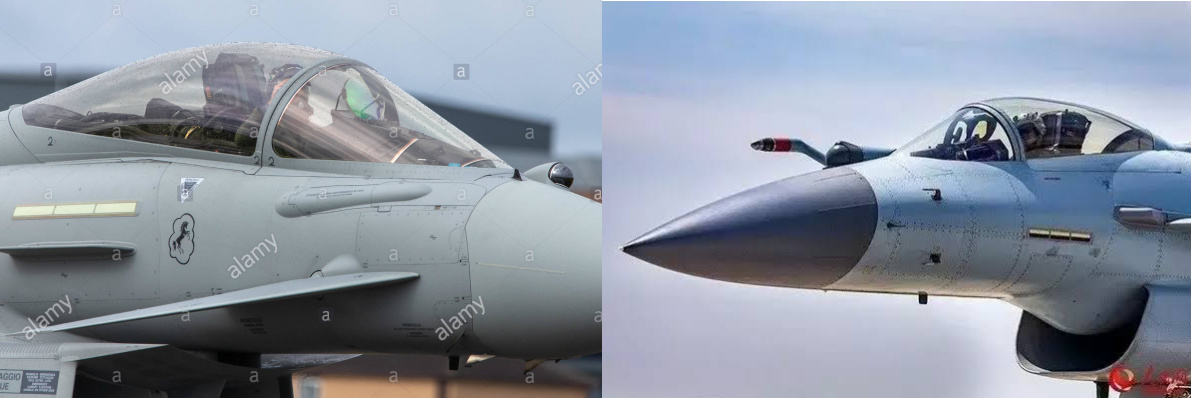
THE QUEEN versus THE DRAGON


Introduction 

Is the Dragon really vigorous? Referring this because J-10 is nicknamed as "Vigorous Dragon". I read various Chinese websites that claim J-10 as one of the most potent machine available in the world. Also, few sources claim it better than western counterpart. One such example is here. Well, it claims J-10 as the "god" of the aircrafts in its generation. (In case if you don't know, Chinese criteria for defining aircraft generations differ from international standards. China defines aircraft generations based upon when an aircraft was integrated into the air force. Per China’s criteria, the J-10 is considered a third-generation aircraft as it was developed between 1990-2000.)


Well, in order to check the statement in which J-10 is considered as "god", it is important to analyse with the available information. Also, comparing it with a counterpart is essential. In a post of my facebook page, I mentioned that Eurofighter is better than J-10 and many people started complaining that I should research before writing. So, here I present my research and detailed analysis in order to compare Chengdu J-10 "Vigorous Dragon" with BAe Eurofighter "Typhoon". It is fair comparison because both the aircrafts are canard- delta wing multirole fighters. Now one more point is that I know China is not an experienced player in manufacturing fighter jets and we should appreciate that how it is working hard to develop sufficient fighter jets at cheap rates unlike the western fighters where money is god. But if you're bringing something in the market, then you should compete with other manufactures who brought the similar product. You need to make you way to the top. Similarly, developing a fighter jet isn't enough. Manufacturer should upgrade it time to time so that it achieve a remarkable position.

This post is also connected with our facebook post. After publishing an article on J-9, various people cursed us in the comments section and demanded us to do a lot of research. So, here I present you the sources:

1) Chengdu J9- Secret Projects UK
2) Chengdu J9- Military Watch Magazine


Without wasting any more time, let's start the comparison:

•Radar

J-10C is said to be equipped with an Active Electronically Scanned Array  (AESA) Radar. The radar name and specifications are not yet revealed and therefore I cannot compare it with it's counterpart this time. So, I am taking KLJ-3 Pulse Doppler Radar here, that is equipped on J-10A. China imported a multi-Ministry EL/M-2032-radar airborne radar, on which later it developed KLJ-3 radar.


Meanwhile, Eurofighter Typhhon is armed with CAPTOR Multimode Pulse Doppler. Even after not being an AESA, the radar is still considered as effective as an AESA radar and hence, the most advanced Pulse-Doppler radar available in the world. It features a mechanically steered array buy the low inertia non-counterbalanced antenna combined with four high torque, samarium-cobalt drive motors offers extremely high scanning speeds. It features a separate data channel exclusively for screening ECM, claiming to offer a robust protection from enemy interference (though a mechanical radar is still more vulnerable to jamming than an AESA set). At this time, range of AESA of J-10 is not revealed. But the range of CAPTOR-M is somewhere between 175-190km to detect fighter jets. Large sized aircrafts like Y-20, Il-76, etc., can be detected within 320km range. Very soon, the radar will be upgraded to CAPTOR-E, an Active Electronically Scanned Array variant.

Here, I place my bet on Eurofighter Typhoon. We don't know about the true characteristics of Chinese radar and therefore, can't assume it as competitive as European radar. And CAPTOR-M, being a succesful and advanced Pulse Doppler, is ofcourse better to detect and track airborne targets.

•Armament
  
Eurofighter Typhoon owns Meteor as it's primary BVRAAM. Metor is considered as world's best Air-to-air missile. It is capable to hit targets under the range of 150km. No Escape Zone (NEZ) of 60 km leaving no chance for the target to evade. It has air-breathing ramjet propulsion system which also provides a max speed upto Mach 4.5–5. A Two way data-link and an active radar target seeker ensures that Meteor reaches its target, even at very long ranges. Two-way data-link enables the missile to be guided by an AWACS or by other aircraft sharing the link in case if the aircraft launching the missile is not in suitable firing range. A jam resistant proximity fuze allows effective precision and course of the weapon. It has the capability to engage targets ranging from fast-jets to cruise missiles, ability to work in all weathers, during day or night, in full electronic countermeasure environments, with effective kinematic performance and a high degree of network-centric readiness.


J-10 on the other hand, use PL-15 BVRAAM, considered as the AAM with the longest range in the world. It has an effective range upto 160–170 kms, few sources report that the actual range may be something around 200 kms or even 400 kms. Thanks to double-pulse solid rocket motor in the propulsion system, it has a a max speed of Mach 5. It also features anti-interference data link system that makes it very much trustworthy for the operators as it is hard to jam even at long courses. Unfortunately, many analysts believe that PL-15 at long ranges is not sufficient to hit highly manueverable targets like fighter jets. It is more like R-37 AAM which is primarily an Anti-AWACS missile. Similarly, PL-15 is more preferred to hit big size targets at 200-400 instead of fighter jets. So, the max range to hit jet like target, the range must be somewhere around 150-160km. But it also depends on NEZ which gives 99% kill assurance. So Meteor is little ahead. In order to precisely hit a fighter jet, J-10 also carries PL-12 BVRAAM. PL-12 (aka SD-10) is a Chinese development but carries similar technology of R77 with little indigenous modifications that can be noticed in the shape and propulsion system. Very few information is available on the internet but after researching about the missile, I came to know that this missile can only engage the targets under the range of 70-75km and has a speed upto Mach 3.5–4. Enough for BVR engagements against potential threats.

Meteor, having a larger No-Escape Zone of 60kms,(source:- Official SAAB website) it is highly accurate and more challenging (if not better) than PL-15.


For Within Visual Range Combat, Eurofighter carries AIM-132 Advanced Short Range Air-to-Air Missile (ASRAAM). It works on Imaging Infrared guidance system and has a low-drag design concept incorporating body lift technology. It is fitted with high-explosive blast fragmentation warhead with impact and laser proximity fuses. It features "both Lock-On Before Launch as well as Lock-On After Launch. ASRAAM has an extremely long range for its class and is very fast (around mach 3.3) – though other WVRAAMs boast higher top speeds, it is believed that ASRAAM’s bigger motor allows it to better retain its speed and helps in gaining almost Beyond Visual Range.


IRIS-T is also an alternative to ASRAAM. It is also an Imaging InfraRed missile. It has Thrust Vector Control installed in the tail. It utilizes a solid-propellant rocket motor. IRIS-T features a roll-pitch IIR seeker with 90° look angle for high off-boresight angle missile engagements. Engagements against targets in the rear hemisphere can be done successfully with the missile locked-on target after launch.(LOAL mode). IRIS-T outstanding agility is the key to successfully engage highly maneuverable advanced aircraft.

For close-range engagements, J-10 carries PL-5 or PL-9 WVRAAMs. PL-5 is said to be a reverse engineered AIM-9 featuring AA-10 technology. It carries a 6kg warhead with laser proximity fuse detonation system. It has a speed upto Mach 2.5 and can engage targets under the range of 18 kms. PL-5E features a double delta canards, a 40 degree off boresight capability, and 40G manoeuvre capability. PL-9, with solid fuel rocket propulsion system and 11.5 kg warhead, can achieve a speed of Mach 2. It has omnidirectional attack capability and good maneuverability.  It has multi-element infrared guidance system that works under the range of 22 kms. Flight control is by long span pointed delta fins at the front of the missile with Sidewinder-type slipstream driven rollerons on the aft tail fin surfaces to prevent roll and so enhance operation of the guidance system.


It is also said that China started integrating their latest WVRAAM PL-10 on J-10. The PL-10 uses the broad-chord narrow-span wing and Thrusy Vector Control system. The missile is fitted with an Imaging Infra-Red (IIR) seeker capable of +/-90 degree off boresight angles. As it is intended for use with stealthy aircraft, notably the J-20, it is likely to have LOAL capabilities with datalink connectivity. Little is known about it at the moment. Therefore, it is most probably in testing phase.

Conclusion is that ASRAAM is better than PL-9 and PL-5 as it features better manueverable capability, Imaging infra-red seeker for accuracy, LOAL and LOAB modes.  Also, when cued with Striker II HMD/S of EFT, missile avails an easy operation during close combat engagements.  Also, it is hard to fool IIR missile with flares.

Comparing IRIS-T with PL-10, it is a tie between both the missiles.

• Agility, Design and Manuverability


Agility is the part where J-10 can prove itself a tough challenge for Eurofighter Typhoon. J-10B recently acquired 3-D Thrust Vector Control system that offers enhanced manuverability. Plus the single engine and lightweight body of the aircraft provides good instantaneous turn rate and thrust-to-weight ratio. According to data available, the latest J-10C has a Thrust-to-weight ratio of 1.15, which is a major improvement over J-10A having thrust-to-weight ratio of 0.98. Eurofighter Typhoon is little ahead here, It has a Thrust-to-weight ratio of 1.25. (source:- t/w of various fighter jets-Angel Fire) So, EFT is our winner here.


In Radar Cross Section factor, Eurofighter features more stealth profile than J-10. According to information available in public domain, Eurofighter Typhoon has a RCS of 0.5m2 while J-10C has a RCS of 1m2.
Sources:- 
•For J-10C-Hushkit

However, RCS isn't a big deal. While carrying weapons, RCS generally increases so in combat, none of the fighter would be "invisible" to enemy radar. FYI, Stealth is not about invisibility. It is all about delay in tracking time by hostile radars. An F-22 can be tracked by radars, but by the time radars pick up F-22 signal, the mission would be completed. In order to maintain the low RCS, 5th generation aircraft concepts feature internal weapons bay.

•Electronic Warfare

In this era 5th generation warfare, Electronics play an important role in combat. With latest aircrafts now operates with Fly-by wire system, jamming is necessary to block critical information supply. Eurofighter Typhoon is equipped with one of the best European EW Suite, the European Defensive Aid Sub-System (EuroDASS). It is a combination of various protection equipments, that provides threat assessment, aircraft protection and support measures in extremely hostile and severe environments. The EuroDASS system comprises an integrated radar warner, Electronic Support Measures (ESM), a laser threat and missile approach warning system, an Electronic Countermeasures System (ECM), decoys, towed decoys, jammers and other sensors and avionics. The ESM/ECM constitutes a powerful radar jamming system. All the subsystems of EuroDASS are managed by a single central computer that is automatic. The EuroDASS displays situational awareness information to the pilot which includes radar and SAM sites while enhancing survivability during military missions. As it a fully integrated system of Eurofughter, it doesn’t require additional pods that take up weapon stations or would influence the aircraft’s aerodynamic performance.


At this stage, J-10 carries an external pod for Electronic Warfare. It is KG800 system. It is capable of disrupting enemy airborne fire control radars and SAM search and fire-control/illumination radars. It also increases the combat plane's survivability against AESA threats that are launched against the plane. It has a Broad jamming radar bands and High effective radiated power. KG-300G pod is an alternative. This pod is designed to counter land-based, airborne, and naval radars at I/J bands, particularly pulse Doppler radars. The pod is highly digitized, and can be installed on a variety of platforms from helicopters to heavy bombers. The system adopts modular design and with open architecture software programming, and it is fully automatic, though human intervention is also optional. In addition to automatic warning, the system can also automatically select and implement the best form of countermeasure. The system is highly adaptive and can be integrated as an overall self-defense system with other avionics such as RWR, and is compatible with MIL-STD-1553B standard.
(Source:- BM/KG300G- Wikipedia)

Now the thing is that this system is carried externally. It either take a hardpoint or increase the payload (either installed on an hardpoint or under the belly). Also, absence of decoy system cannot be ignored. Decoy System helps in fooling incoming guided missiles which are highly advanced and a fine example here is Meteor which is hard to jam as well as hard to fool with Chaff.


Eurofighter Typhoon, with the integration of EuroDASS, can equip itself with Leonardo BriteCloud Decoy system. It is small, compact, DRFM-based active RF countermeasure that has the capability to defeat the majority of RF-guided surface-to-air and air-to-air threat systems. It is small in size and hence, compatible to be dispensed from standard chaff/flare dispensers and therefore requires minimal platform integration. Utilising advanced techniques it is effective against active and semi-active RF seekers, and fire control radars.

So now we finally completed our comparison. And in every factor, one can observe that Eurofighter is better than J-10 in every aspect. Now, many would say that China is inexperienced, new in this field, good if not betterbla bla bla. Fact is that they created something and now they should compete. I am not denying the fact that their products are good. Ofcourse the weapons are good but it is unfair to say "better than others" without any analysis.

And yes, I excluded few factors due to reasons mentioned below:


• Ground attack capability:- As a single-engine aircraft, J-10 comes in lightweight multirole category while EFT comes in mediumweight multirole category so it is obvious that EFT has more payload capacity. But in case if you want the info, Eurofighter Typhoon has payload capacity of 9000kg while J-10 has a payload capacity of 7,500-8000kg.


• Range:- Both aircrafts are capable of mid-air refuelling. In combat operations, tankers also play a significant role by extending the combat radius of the active aircraft. But in case if you want the info, J-10 in air-to-air engagement+3 drop tanks configuration, has a range upto 1,380-1,390 kms. Eurofighter Typhoon in air-to-air engagement+3 drop tanks configuration, has a range upto 1,200-1,250 kms.


•Speed:- Speed of the aircraft is not same everytime. It is affected by altitude, weight (of the aircraft) and payload. In case of fighter jets, speed is important for interceptor aircraft like Mig 21 but not multirole aircrafts which supposed to carry heavy (heavier than Interceptors) ordanance. But in case if you want the info, speed of J-10 is 2,720 km/h. Eurofighter Typhoon has a speed of 2,500 km/h.

So overall, Eurofighter is better than J-10 in almost every aspect. I agree that there isn't much data available about J-10. But we are comparing the specifications with every info available at this moment. In case if we missed something, let us know via the comments.


Thanks for Reading!