Sunday, May 30, 2021

Unreliable J-15, Obsolete B-52, incapable Tejas and more: A look at major Myths regarding modern military aviation and realities


Since the revolution of internet has begun, the scale of information transfer has increased upto a scale where 8 out of 10 people today consider internet posts as their source of information. While it indeed serve as an outstanding platform for necessary data sharing, the readers should also be very much critical on what they see, what they believe and what they share. 

The public discussions and debates related to strategic affairs are always a subject with limitations. A proportion of information never make it to public due to "risk of national security" and the ones that made it, also contains some made -up and assumed figures, such as radar range estimates, radar cross sections, and many such more data which are only shared among actual operators.

However, discussions on forums also offers a great deal of information, but flaws are emminents and needs official clarifications based on facts and figures provided from actual statistics and thorough analysis. These flaws give birth to Myths and these are most utilised to win any arguments, specially on social media platforms that is no less that a digital battlefield.

Sources of Myths


Before heading straight into the topic, it is necessary to understand that myths can be sourced from anywhere on web. But most specifically, these arrive from nationalist media of rival countries. A media house based in China may find several errors in F-22 while US based media can point out flaws with J-20. Second can be various social media handles with mass publics, whose tweets are sometimes converted into news and it all then spreads like a virus (well that's a well understandable example to define).

Another is clickbaits, where the entire focus is on luring people to click the link. These usually do not contain any credible sources (or in many instances, there isn't even one).

Another is very famous, the armchair generals found on social media. With speculations driving their theories, the

So lets now head into the chapter and see the realities behind some of the major military aviation myths.

1. Unreliable Chinese J-15


Majority of the Chinese origin weapons remain under long-term controversy due to their lack of originality. Ground vehicles like DongFeng Mengshi family that resembles a lot to HMMWV "Humvee", helicopter like Z-20 that shares a near accurate design as that of UH-60 "Blackhawk", combat aircraft like J-15, that is the same design as that of Russian Su-33, that we are going to talk about in the following:

Myth:

J-15 is unreliable for deck (carrier) operations due to large size and heavyweight characteristic.

Fact:

The Shenyang J-15 "Flying Shark" final design was prepared after thorough study of a Su-33 unfinished prototype named T-10K, that was recieved from Ukraine back in 2001. The airframe was evaluated by Chinese engineers at AVIC and following similar improvements as that of Russians, Chinese developed a matured variant from the unit. Hence, design similarities between J-15 and Su-33 are obvious.

While it is indeed true that the aircraft is heavyweight, with Max TakeOff Weight (MTOW) of 6.5 tons according to expert figures, same as that of original Su-33. However, as both the aircraft carriers in service with PLAN are in Short TakeOff But Arrested Recovery (STOBAR) configuration, the aircraft needs to generate enough power on the launch point to achieve the required lift for takeoff, unlike the USN CATOBAR carriers that comes with catapult sytem for quick launch of fighters. Therefore, the payload affects the J-15's takeoff ability and it needs critical inspection of the loadout before the operations.

This, however, isn't at disadvantageous as it is projected in various forums. The aircraft do have limitations in its payload capacity, but still can carry a loadout in variety of combinations. 

1. 4x PL-12 BVR-AAMs and 2x PL-8 CCMs for standard Combat Air Patrol, occupying nearly 1 tons of weight.

2. 4x PL-12 BVR-AAMs and 4x PL-8 CCMs for standard intercept, occupying nearly 1.5 tons of weight.

3. 2x YJ-83K Anti-Ship Missiles, 2x PL-8 CCMs , and 2x PL-12 BVR-AAMs for standard anti-ship operation, occupying nearly 2 tons of weight. 


These specifications are already tested, demonstrated and actively in service without very much of the issues. Being a fighter tasked for the role of a carrierborne air superiority platform, the organisation expects its performance to be sufficient to deal with variety of threats in the sea as well as over it.

The size of the aircraft, is indeed massive, as it is based on Flanker family ofcourse. With Length of 21.9 m and wingspan of 14.7 m, one squadron of the aircraft constitures significant space on the deck. Small deck size was another factor that lead to procurement of MiG-29K by Indian Air Force, technological superiority was another factor. A J-15 occupies complete space (till the edge) on the elevator/lift of PLAN "Liaoning" aircraft carrier, the first aircraft carrier in service and first to host J-15 fighter squadrons, followed by PLAN "Shandong", developed in house by the nation under Type 002 project.

Conclusion:

The aircraft do have some limitations when operating from aircrafts carriers, but still not ineffective as stated by many other information outlets. Infact, even if it suffer such problems, the Chinese has no other option for its replacement. The current planned FC/J-31 5th generation fighter aircraft for career operations is not yet ready and PLA planned to deploy the same J-15T on their upcoming Catapult equipped Type 003 aircraft carrier. However, there are also speculations on an under development J-31 naval derivative that will eventually replace the 4th generation J-15 and upgrade the PLAN air arm to the standards of west, where 5th generation platforms are actively participating in combat ops. 

2. B-52 is now obsolete


One of the most common theory that we come across in various discussions is that bombers are now obsolete. Back in time, the bombers, as the name suggest, were defined as "bomb trucks" which could accommodate a heavy payload of munitions in its bomb bay, that was not possible for any fighter aircraft. And even today, the payload capacity of aircrafts like US B-52 "Stratofortress", or Russian Tu-160 "Black Swan" is still unmatched by any fighter jet in the world. However, what critics believe that as the bombers were originally configured for conventional bombing, with direct insertion into the combat zone, the present era with precision guided munitions reduced the necessity of conventional bombing. And introduction of Betond Visual Range (BVR) air-to-air missiles, the bombers would be under high risk while operating in a mission.

Myth:

As Precision Guided Munitions are most commonly used strike solutions, old age bombers are now obsolete for modern warfare

Fact:

While the quantity of strategic bombers present in the modern era is quite less than what was in the previous century, they still hold a significant psotion in Air Force of US, Russia and China. USAF at present has 3 types of strateguc bomber platforms available, that are: B-52H "Stratofortress", B2A "Spirit" and B1B "Lancer". While there is a complete generation gap between B-52 and B-2, the B-52 still adapted to face modern day challenges, since it's induction in 1955. The aircraft analog intruments are now replaced with digital systems, radars are enhanced for better precision and EW suite providdes better survivability durong combat missions. The aircraft has now more diverse weapon package than Cold War. 


Even though a lot of critics, conventional bombing is still practised in many situations. A chain of enemy fortifications, or a convoy of vehicles, both are very common targets in battlefield and hence, a carpet bomb deployement is preferred for heavy effect. However, this is safe only when the airspace is not contested and free from any adversary air-to-air or surface-to-air threat, eg Afghanistan, where coaligion forces on ground recieve Close Air Support on regular basis. While it's also true that precision bombing is now more common, the B-52 also integrates solution for this as well. It is now capable of carrying satellite guided Joint Direct Attack Munitions (JDAMs), AGM-86 Air Launched Cruise Missile (ALCM), Joint Air-to-Surface Standoff Missiles (JASSM), and much more, all that can be deployed from far way ranges (standoff) without directly entering the combat zone. This ensures the safe in-flight operarions of the aircraft.

Conclusion:


While B-52H is old, the aircraft still holds a lot of potential to follpw the offensive doctrine of United States military and one of the most effective asset to be utilised in battlefield and case heavy damage to the adversary. Even the counterparts, like Russian Tu-160 and Chinese H-6, are very much capable of large scale bombing of any hostile strategic location, by deploying necessary munitions at standoff ranges, safe from interceptors.

3. Immature Su-57


The period of Cold War witnessed immense development and funding by superpowers on strengthening their military arsenal. From secretly developing high grade platforms for offensive tasks, to mass producing assets in order to keep the military preparedness high throughout the year. However, as the USSR disintegrated in 1991, the economy declined drastically and US held the position as the sole superpower, with status untouched by any other nation or even regional alliances. However, succession of Russia didn't put the military research and development at stake. The funding was indeed cut short and major programmes were either delayed or cancelled, but few still made their way to still make Russia as one of the strongest nations and weapon exporter of the world. The latest 5th generation Su-57 "Felon" is one kf the examples.

Myth:

Even after being new, the Russian 5th generation fighter aircraft is still nowhere close to true 5th generation standards

Fact:

Before directly jumping into mythbusting, we need to understand what actually are the criterias for an aircraft to be called as 5th gen:

1. Supercruise: Ability to sustain supersonic speeds for higher time, without afterburners. It can be attained by reliable engines with fuel efficiency and light airframe (not to be confused with overall weight).
2. Stealth: Ability to avoid radar (airborne or ground based) detection for long time. It can be attained with coating of Radar Absorbent Material (RAM) and composites.
3. Data fusion: Capability to recieve, process, utilise and transfer multiple data at faster rate, along with networking with other units.
4. Low Probability of Intercept Radar (LPIR): Radar with low radiation spread, that heps in dodging enemy passive radar systems.

All these are, infact present in the Su-57. The main argument is the delay in the aircraft's induction by the owner, Russian Federation itself. Started under "PAK FA", project was kickstarted in 2002, with Sukhoi leading the design phase. The first prototype T-50 took the skies for first time in 2010, officially rivaling the American counterpart F-22 "Raptor", 10 years late than the latter.


However, the funding was not enough and Russia approached its allies offering joint development of the platform. India, that was itself searching for new Multirole fighters was a suitable contender and it went succesful when Fifth Generation Fighter Aircraft (FGFA) programme was approved to jointly produce a customized variant of Su-57 and share the costs of development. However, there were still dissatisfaction regarding the costs between them as well, leading to further more delays, and causing Russia to independently invest on its first 5th generation aircraft.

Now while the aircraft has recieved its first official order in 2020 for 76 aircrafts, the point is clear that it is late. Another fighters in the same league, the Chinese J-20 entered service in 2017, even when the first flight took place an year later than T-50. The drawbacks are that the production plant will first focus on fulfilling the requirements of Russian Air Force and then looks at exports. Another drawback is the crash occured in 2019 during a test flight of the serial produced unit (bort number "01 blue) due to control system failure. While it was not first time a jet crashed during a testing stage or even a 5th generation platform, it really affected the reputation on Russian aerospace firm and most specifically, the Izdeliye 30 engines, exclusive to Su-57 and will be present in the serial production variant as well.

However, crashes and accidents during test stage of a system are sometimes beneficiary(with lack of fatalities), as the enguneers will be able to make necessary tweaks related to software, hydraulics or any other component that suffered failure. 

Conclusion:

With a rich history and experience of producing some of the marvellous families of fighter aircrafts from Mikoyan and Sukhoi, and also recieving interests from many foreign customers, it is expected that Russia will be able to attain the necessary equivalent of 5th generation platform to its adversary in coming years, while also offereing significant edge to the allies from regional threats.

4. Incapable Tejas


Tejas is a single engine lightweight fighter aircraft, and second combat jet to be researched and developed within India. The aircraft is primarily focused to replace the ageing fighters of the Indian Air Force, including the MiG-21 "Bison" and retain the role as a "point defence" fighter. With an attempt by the nation to attain self-reliance in the defence industry, many derivatives of the platform are also working in parallel, that includes twin engine OmniRole Combat Aircraft (ORCA) and Twin Engine Deck Based Fighter (TEDBF), sharing similar design characteristics albeit differences in roles and major components. 

Myth:

Tejas took a long time for development and hence, a highly immature and incapable platform

Fact:

The Tejas came out from the LCA programme initiated in late 80s, with the final design was freezed in 1990 and original Phase 1 for full-fledged development started in 1993. After overall design and avionics tested both artificially and on ground, the first prototype/technology demonstrator took the skies in year 2001, 8 years after the full-fledged development initiated. When now when we compare it with Chinese J-10, that started its full-fledged development in 1986 and first flight took place 12 years later, in 1998. And also looking at Eurofighter Typhoon, that started its full-fledged development in 1983 and took the skies from first time in 1994, 11 whole years. Therefore, when it comes development period, the HAL LCA managed to take the flag earlier than other similar projects.


However, the original issue is the time taken for formal induction into the service and actual deployement on operations. After completion of all the trials using technology development units and limited series production unit, the Indian Air Force introduced first squadron of LCA in 2016, albeit in Initial Operational Clearance (IOC) configuration that was awarded in 2011. With 10,000+ flying hours in the inventory, and integrating out minor additions like an In-flight refuelling (IFR) probe and a 23mm internal cannon, the Tejas recieved a go-ahead for Final Operarional Clearance in 2019. As every weapon system enters a IOC phase, the transition from IOC to FOC always take time extending from 5 or more years in order to check the durability, resilience, performance and endurance of variety of componets integrated.

While this was all about the time period, now lets come to Tejas capability. It is worth noting that the Tejas Mk1 and its combat capability is still based on what was proposed in early 2000s. Effective Beyond Visual Range (BVR) capability to achieve the interceptor class. With Elta EL/M-2032 radar, the Tejas Mk.1 can track a 5m2 RCS fighter sized targets upto 120kms and engage them with its I-Derby medium range air-to-air missile, either in Lock On After Launch (LOAL) or Lock On Before Launch (LOBL) mode. On a standard intercept, it can carry upto 2-4 BVR-AAMs and 2 CCMs. With provision of Elbit DASH IV (Display and Sight Helmet), the platform operator can actively deploy necessary weapon to engage the adversary. These capabilities are indeed what is necessary to replace another interceptor like MiG-21, that is a decent and lethal firepower to face hostiles under quick response. Reportedly, the actual deployement, replacing a MiG-21 squadron will soon take place between 2021-22, allowing it to undertake combat missions. In 2020, amid military crisis with China, the platform was temporarily deployed in the western sector but backed out after completing the period.

However, Tejas Mk1 is still not satisfactory for the Indian Air Force to attain the edge that it is looking for. The Tejas Mk1A proppsed back in 2015 and finally recieving clearance in 2021. This particular standard's effectiveness is what the Tejas was expected to provide earlier. Further enhancing the engagement capabilites, the Tejas Mk1A will offer true multirole capabilities with interation of new Precision Guided Munitions (PGM) and Anti-Ship Missiles, as well as integrate an indigenous Active Electronically Scanned Array (AESA) radar, Uttam, researched and developed by state owned Defence Research & Development Organisation (DRDO) and in final phase of tests.

Conclusion:

While the Tejas Mk1 is indeed late when it comes to the period from first flight to actual operational sorties. The programme had to face various political hurdles and financial backing as well, creating further problems for the Indian Air Force. However, with progress fast tracked with new orders and costing alloted, the Tejas will soon see itself as a trustworthy asset in the South Asian region.

5. China's neglectance on JF-17


It is well known fact that JF-17 is developed by Chinese Chengdu Aerospace Corporation and development was assisted by Pakistan Aeronautical Complex. It is a light jet fighter capable of carrying out multi role operations. It is specially customised for Pakistan Air Force. Right now, there are 2 active variants: JF-17 Block I and JF-17 Block II. Twin seater JF-17B is in testing phase and Block III under development. The Block I JF-17s were developed by China and then parts were imported by Pakistan, where they assemble it. Block II is more indigenous than Block I as few internal components and airframe structure are developed in Pakistan, and China's share in manufacturing declined. Production of both Block I and Block II variant are now stopped in order to focus on development of Block III. 50 JF-17A Block I, 62 JF-17A Block II and 26 twin seat JF-17B Block II aircrafts are produced till date and overhauling of Block I aircraft to Block II standards is under progress.

Myth:

The underperforming attribute of Sino-Pak JF-17 is what makes China to reject it for its own Air Force

Fact:

There is a wide misconception in the minds of people regarding the question: why China, even after being the main contributor in the project, doesn't operate any unit of this aircraft in it's air force. Trolls are always available to blame the aircraft's "poor" performance and capability. But in reality, this is where they are wrong.

In order to understand the concept, a variety of factors are required to be explained. Let's start with operational environment and doctrine of both the nations. Pakistan is a country having a water body in the south and rest sides are surrounded by landmass of neighbour countries. It has barely 882,000 square kilometres of land available. Talking about China, it has 9,600,000 square kilometres of land available. You can see the difference. How both countries differ in area size. China has much much bigger area to control. And to protect it, they need aircraft suitable to operate in their sorroundings. China which is heading towards the status of next superpower, need equipments to "project power". As a rival of US, China needs something comparable to their weapons. JF-17 is a low budget fighter with limited BVR capability (2 BVRAAMs at a time but can be increased to 4 with dual racks), low range radar and light payload. It is only to patrol the borders but not to show some power to adversary. To show a power, aircrafts like J-11, Su 27, J-10, J-20, etc., are required which feature high end avionics and wide operational capabilities.


Second is project's expectation. Pakistan approached China for a low budget fighter, specially after the Super 7 project was scrapped due to sanctions placed by United States. Therefore, the aim was to develop a low cost aircraft with average avionics. With average level avionics, JF-17 wasn't intended to feature state-of-the-art and high quality avionics in order to perform heavy combat operations. Pakistan's main rival is India. Afghanistan don't have a strong air force, Pak-Iran relations are very good and China is their ally. So the only challenge in the neighbourhood is Indian Air Force which operates a good range of fighters. So they need to compete with India by creating an aircraft that can increase thr strength (numbers) of the air force. On the other hand, China already operates fighters like J-11 for air dominance role, JH-7 for strike role, F-7 for interception role and their most trustworthy aircraft J-10 for light-medium multirole. J-10 fulfills the same role as JF-17. Therefore, it is not possible for China to dump their indigenous fighter and choose another aircraft that was not suitable for their operational requirements.

Third is interest. Pakistan is not a major Economic power. It has experience of operating single engine fighters for a long time (they also operated twin engine Shenyang J-6 aircraft). Single engine fighters are easy to maintenance and less expensive than twin engine fighters. So Pakistan is more interested in single engine fighters as it comes in their budget comfortably. When we take a look at China, we see how they started leaning towards twin engine fighter familes. J-16, J-20 and J-31 are some fine examples to prove my point.

Conclusion:

With all this detailed explanation, it can be understood why JF-17 was never intended to be used by Chinese Air Force and they are more happy with their own arsenal. Succesful purchases by Myanmar and Nigeria also talks about the trust on platform (while cost also played an important), and assures that the aircraft is best suited under its destined role as a lightweight multirole combat aircraft.


Therefore, these are, while not all, but some of the most famous military aviaitim myths that we encounter on regular basis. The information provided are available on open source and backed by some trustworthy sources including the developers themselves.

While there is no end to fake news, to offer a fair analysis and comparison, it is always necessary to be a responsible actor and finding the actual case behind any news on social media. Not just on the defence but in any field of subject, a critical inspection should be the first priority before turning a claim into fact. 

Keeping in mind that this series will soon followed by another part, make sure to give us a follow on our official page Military Marvels. 

THANKS FOR READING !


References:


Tuesday, September 1, 2020

Low Cost Fighter Options For Bangladesh Air Force (if MRCA plan doesn't work out)


Located deep in South Asia and almost surrounded by a major regional power from all sides, Bangladesh is a small country that declared itself Independence in 1971 after a fierce battle with occupation forces. But today, it is very bright nation with rapid growing economy and improved infrastructure system as well as administration. To protect this nation, Bangladesh armed forces are well trained and well equipped to meet the regional challenges. In 2016, the Para 1 Special Forces utilized their effective training and tactics to neutralize a major terrorist attack, and without suffering causalities. Talking about political relations with neighbors, Indo-Bangla relation is filled with  cooperation in some issues and disputes in some. And overall, it is very balanced. Bangladesh is having some issues with Myanmar (Burma), with which it shares a small border. The Myanmar military is arming itself consistently. In 2018, Myanmar placed an order for 6 Sukhoi Su-30SME aircrafts and it is expected to be delivered by this year. Bangladesh Air Force, on the other hand, is yet to order any new aircraft. But it is in search of European fighters under the tender of Multi Role Combat Aircraft (MRCA) that is expected to be signed by the end of 2021.

BANGLADESH AIR FORCE

HISTORY

Formed in 1971, Bangladesh Air Force holds a prominent position in guarding the country like every other respective Air Force around the world. It was formed under tense situations. With less than 70 officers and 7 pilots, BAF took part in Liberation War in order to gain independence from Pakistan. And they called themselves Kilo Flight. In December 1971, the Kilo Flight carried out some successful air strikes using armed DH-3 Otter propeller aircrafts and Alouette III helicopter. Between 4 December to 16 December (about 12 days), they carried out 90 sorties and conducted 40 combat missions to hit strategic assets of Pakistan ground forces. 

The leader of Bangladesh freedom struggle, Sheikh Mujib-ur-Rehman with Kilo Flight officers and Alouette-III helicopter
(Source)

Soon after Independence, Bangladesh Air Force received weapons and equipment from regional ally India and Soviets. The weapons include MiG-21MF and MiG-21UM aircraft Some ex-Pakistan Air Force F-86 "Sabre" jet fighters were also repaired and pushed into service. 

PRESENT

Today, Bangladesh Air Force operates a small fleet of fighter aircrafts, with majority of 3rd generation Chinese origin F-7 fighters. The most capable fighter in BAF is MiG-29SE "Fulcrum". Since 2000, Bangladesh is operating 8 of these aircrafts. It is equipped with Phazotron N-019 Pulse Doppler radar. It is said to have max tracking range up to 50-55km. It allows the integration of Radar guided missile like R-27R and hence engaging targets within radar range. According to local sources, Bangladesh decided to send the MiG-29s to Belarus in order to upgrade it into BM standard that includes minor external changes as well as internal upgradations.

On the other hand, F-7 fleet is filled with variety of variants. F-7BGI is considered as the most advanced variant of the J-7 family and exclusively in service with BAF.  KLG-6F Fire Control Radar offers Beyond Visual Range (BVR) capability. But the F-7 is pretty old aircraft with aged airframe. Categorized in early 3rd generation category, there is an abundant number of old F-7 airframes the completed the service life with BAF and needs retirement. 


Other than dedicated fighter aircrafts, Bangladesh Air Force also operates abundant jet trainers like Hongdu JL-8 and Yakolev Yak-130, that can be used as a combat jet if situation arises. One thing that really impress everyone is the utilization of resources by Bangladesh military. Even with small budget, they are trying their best to invest funds for good quality weapons. And they are trying to shift to western weaponry through the current modernization plan. Rival country Myanmar owns some air power advantage over the Bangladesh Air Force and this is the reason why BAF launched the MRCA tender. Other than MRCA, Bangladesh also planned to procure Chinese UCAVs and American AH-64E attack helicopters.

BACKGROUND ON MRCA TENDER 

In 2017, an official document was published by Bangladesh's Directorate General of Defence Purchases (DGDP) with details regarding tender for Multi Role Combat Aircraft (MRCA). The quantity of MRCA requirement was specified to be 8, but with 4 additional units as an optional purchase. The MRCA specifications, according to the details mentioned in the document, are as follows:
 
1.  It should be twin engine design, with each powerplant providing 5,500kg of dry thrust and 8,000kg or more with afterburners enabled.
2. It should feature Active Electronically Scanned Array (AESA) radar with air-to-air range up to 150km
 or beyond and air-to-surface range up to 50km or beyond. 
3. It should feature integrated Electronic Warfare suite with high Electronic Counter Counter Measure (ECCM) capability. 
4. It should feature a Helmet Mounted Display and Sighting (HMDS) system
5. It should feature 8 or more external hardpoints, with overall payload capacity of 5,000kg or more.

The tender is also supported by political leaders of the country. The President of Bangladesh, Abdul Hamid also assured that government is ready to spend on defence acquisition.

CHANGES WITH TIME

Bangladesh invests 6.1% of its total budget in military, costs somewhere around 4.1 billion USD. Therefore, Bangladesh has to manage it's expenditure with these funds. But defence purchases are not made from yearly budget funds. An additional amount of money is allotted to the ministry managing the deal. It is already confirmed by high Bangladeshi officials that funds are already allocated to proceed with MRCA tender. Now all they need is to choose the most compatible option among the contenders. However, several changes are being made in the tender since the beginning because of factors like Politics, budget, etc., and the current situation of the tender is different from the initial state. Now BAF requires 16 fighters in place of only 8. This will make sure that the Air Force operate a complete squadron of modern 4+generation aircraft. But the major change occurred in the tender was unofficial rejection of MiG-35.

The first ever contender to join the MRCA league was Russian origin MiG-35. The Bangladeshi officials were invited by Russia to evaluate/check the performance of the aircraft. It was believed that the aircraft was the most suitable option in the competition. Along with MiG-35, Su-30 was also in Bangladesh interest list. However,there were some big political issues that started with Su-30SM deal with Myanmar. The Russians were offering Su-30 to Bangladesh too but with a high price that seems unfair to Bangladesh. And with the success of Myanmar deal, Bangladesh felt that it may not be a good move to acquire the same aircraft. Adding insult to injury, Russia also supported Myanmar in its stand on Rohingya crisis, an unsolved dispute between Bangladesh and Myanmar that is caused due to huge displacement of Rohingya Muslim population from Myanmar, causing huge refugee population to move into Bangladesh. All this unofficially confirmed that Bangladesh would never acquire MiG-35 under the MRCA. 

MAPO MiG-35 "Fulcrum-F"

Before this tender, Bangladesh also tried to acquire multirole aircraft but somehow, failed to do so. It was American made Boeing F/A-18 "Hornet". It was not a part of MRCA tender that was launched in 2016. The time goes back to 2008 when aircraft was supposed to be perfect for Bangladesh maritime surveillance and strike capability. Going with unconfirmed sources, the chances of F/A-18 were not only high, but in fact, Bangladesh was very close to ink a deal for 12 units of the aircraft. The pilots were also sent to USMC training base to perform the basic training. Unfortunately, the deal was cancelled due to some reasons, one stated to be the shortage of USMC's own fleet.

A pilot from Bangladesh with USMC F/A-18
(Source)


CURRENT LEADING CONTENDERS 

There are some speculations of possible winner. And it is not a Russian or Chinese fighter, but a European battle machine. 

Eurofighter Typhoon

The Eurofighter Typhoon fulfills everything that Bangladesh needs under the plan. Twin engine with 5,900 kg in dry thrust and 9,080 kg with afterburners, internal EuroDASS EW suite, Striker II HMDS, 3 hardpoints with 9,000kg payload capacity. A next-gen AESA radar, called Captor E is also going to be operational with the jet by the end of this year. Outside Europe, Eurofighter is very successful in impressing customers in Middle East like Qatar, Kuwait, Oman and Saudi Arabia.

Royal Air Force Eurofighter Typhoon

According to Bangladeshi analysts, Bangladesh has two ways to acquire the EFT. First is to sign a deal for fresh aircrafts. As a joint development, 4 nations (United Kingdom, Germany, Spain and Italy) own their rights over the Typhoon. Therefore, Bangladesh has to gain approval from 4 countries before signing the deal. Then wait 3-4 years to recieve delivery. Second way is to purchase 2nd hand units. The Royal Air Force is facing budget issues and Typhoon requires high cost for maintenance. If somehow, UK agrees to sell surplus EFTs to a foreign nation, Bangladesh can reach to grab the opprtunity. It also offers delivery in shorter time, because 2nd hand units can be used comfortably after refurbishment. The tranche 2 variant is suitable for Bangladesh operation field.
 

Dassault Rafale

The latest entry in the competition. The official offer for Dassault Rafale was made during French Defence Minister Florence Parly visit to Bangladesh in March 2020. In her meeting with Prime Minister of BangladeshOn comparing Rafale with Eurofighter, the French aircraft holds the high ground. A variety of advantages like RBE-2AA AESA radar, SPECTRA suite, and better long range/standoff strike capability. The weapon package of both the aircrafts are same because of common supplier. For example, MBDA Meteor is the primary BVRAAM for both the aircrafts. Difference in CCM (Close Combat Missile) depends on customer preference, whether they want MICA NG or IRIS-T or ASRAAM (Advanced Short Range Air-to-Air Missile).

Indian Air Force Rafale DH F3R

Like Eurofighter, Rafale is also succesful in Arab with two nations, Egypt and Qatar operate the aircrafts. Outside Middle East, India recently received first five of the 36 aircrafts ordered back in 2016. And very recently, Greece also confirmed purchase of Rafale jets. India is the only customer of Rafale that ordered Meteor BVRAAMs while Qatar and Egypt operates with MICA missiles. There is no doubt in strike capability of Rafale as it proven its mettle during strikes in Libya and Syria against Islamic State terrorists. The EW capability against the air defence systems is also remarkable, with Active Radar Cancellation provided by SPECTRA.

The two ways of acquistion are also available for Bangladesh in this case. In the recent news, it is confirmed that Greece is going to acquire 18 Rafales from France, but out of 18, 8 Rafales will be provided free of cost. These 8 units are presently in service with French Air Force and hence, will be donated to Hellenic Air Force in the present when tensions between the Greece and Turkey are pretty high. Therefore, Bangladesh can also acquire 2nd hand units by paying low price, instead of spending more money and more time. 

LOW COST ALTERNATIVES

Sometimes, the ambitions doesn't fit perfectly with the budget of the country. Many nations who expected to purchase good quality weapon ends up choosing cheap alternatives to save cost. It is uncertain what can be the outcome the ongoing competition of MRCA for Bangladesh. But if we compare the military budget of this country with other powers in the region. It is far less and it is obvious because of the doctrine followed by Bangladesh and it's relations with neighbouring countries. It doesn't have hostile relations with India that shares border on every side. The low-to-medium hotile nature with Myanmar is not expected to turn into a large scale military conflict (for now). And therefore, Bangladesh preferred to focus more on its economy, today making it a prosperous and significant in the region. So, spending huge money on European MRCA may or may not be final step. And the government may decide to choose cheap alternatives in this regard. Therefore, here we can speculate some of the options that may serve as perfect alternatives of European platforms, but at low cost:

CHENGDU J-10 "FIREBIRD" - CHINA

People Liberation Army Air J-10A "Firebird"

More than 350 units produced, Chengdu J-10 is presently the most trusted single engine fighter jet by China. With  three available variants, the J-10 is evolving its capability since it's induction. Following are the characteristics /capabilities of J-10C that makes it a suitable low cost contender of MRCA:-

1. Considered as Chinese counterpart of F-16 "Fighting Falcon".
2. Indigenously developed Chinese AESA radar, conpatible to link with PL-15 BVRAAM, with a range upto 150-160km.
3. Infra Red Search & Track (IRST) sensor and Helmet Mounted Display and Sighting (HMDS) system, allowing High Off-BoreSight(HOBS) engagement capability with PL-10 CCM.
3. 11 hardpoints with payload capacity of 7,000kg.
4. Costs around 30-40 Million USD.

Only problem is it's single engine configuration, however, it allows low spending on maintenance. The aircraft is yet to receive success in export market. China tried to offer the aircraft to Pakistan on many occasions. But Pakistan always preferred to continue and support JF-17 program that is more successful in export market than J-10 today. Also, it is yet to experience any combat. But going through the data on paper, it is assured that J-10 has a lot of potential. And it may not be a bad choice for Bangladesh Air Force. 

It's acquisition is also a possibility because of closer ties between Bangladesh and China at political level. Chengdu also offered to set up a plant in Bangladesh if it offers purchase the aircraft. And according to many analysts, all this favors J-10 chance for Bangladesh a lot.

CHENGDU/PAC JF-17 "THUNDER"

Pakistan Air Force JF-17A "Thunder" Block 2

Dominant when it comes to price factor. A JF-17 Block II costs only 25 million USD. It is because Pakistan also wanted to operate a low cost fighter with average quality systems. But even with such systems, JF-17 is potent war machine that fulfills the role of front line fighter for Pakistan Air Force. The most latest variant is Block III, that completed its maiden flight in late 2019 and in final stages of development. The aircraft is planned to be equipped with:

1. Chinese KLJ-7A AESA radar, with PL-15 BVRAAM compatibility. 
2. HMDS and HOBS missile like A-Darter.
3. Anti-Ship strike capability with C-802K and CM-400AKG, with assumed range around 180-250kg.

JF-17 is also successful in export market. Myanmar is the first export customer while Nigeria is scheduled to receive first batch in late 2020 or early 2021. Any country that really want a good low budget fighter, cannot ignore the JF-17. But hurdle for Bangladesh here is Myanmar that also operates the aircraft. Like the Su-30 issue, purchasing the same aircraft that rival also use may not be a good idea for BAF.
 

HAL LCA "TEJAS" - INDIA

Indian Air Force HAL LCA Tejas Mk-1

A very young fighter in the league. It received Final Operational Clearance (FOC) in 2019 and the first FOC unit inducted this year. Tejas has only 1 variant for now, that is Mk-1 but it is believed to be trustworthy, as Indian Air Force recently deployed it near the Indo-Pak border due to rising tensions in the region. But the variant of Tejas that is expected with high hopes is Mk-1A. It is planned to feature significant upgrades over Mk-1. And here are the highlights:-

1. AESA radar, either indigenous Uttam or Israeli EL/M-2052, with Astra BVRAAM.
2. HMDS system and high off-boresight ASRAAM CCM. 
3. Anti-Ship capability with BrahMos NG
3. Lightweight design and less maintenance cost. Unit cost will be reduced once it enters mass production. 

But the main problem here is it's availability. Tejas Mk-1A is neither produced nor ordered by IAF yet. It is facing delays due to price negotiations. So, it is early to talk about the aircraft now as it is not yet physically available. But capability wise, it is highly appreciable and Bangladesh may consider it as a low cost, budget fighter but a capable bird to fulfill the requirements.
 

DASSAULT MIRAGE 2000 - FRANCE

United Arab Emirates Air Force Mirage 2000-9EAD

The capabilities of Mirage 2000 are, unfortunately, not as good as 4+ generation aircrafts. It is still equipped with Pulse Doppler radar. And the strike capability is yet to evolve in order to match Rafale or Eurofighter standards. But talking about some key highlights:-

1. It features RDY-2 or RDY-3 (exclusive to 2000-9) radar with has capability to fire MICA missiles, highly effective modern AAM for both Beyond Visual Range (BVR) and Within Visual Range (WVR) combat.
2. It is equipped Integrated Counter Measures Suite (ICMS) that provides Self Protection in electronic environment.
3. Payload capacity of 6000kg and wide range of ordnance compatibility.

It's a fact that Mirage 2000 is no more in serial production and production line is replaced by Rafale. But there are many Air Forces in the world that operates surplus Mirage 2000 aircraft even in the presence of high technology aircrafts. United Arab Emirates Air Force is an example, it operates the most advanced F-16, that is Block 60 alongside 63 Mirage 2000-9EAD. Even though Mirage 2000 is highly capable in its fleet, UAE may provide it to Bangladesh because of their common religious status (that's just one factor). Then there is Taiwan that is planning to retire the whole Mirage fleet. Bangladesh can acquire those Mirage 2000 with refurbishment and upgrade from original manufacturer Dassault. French Air Force also operates a huge number of Mirage 2000 in the inventory but very soon, Rafale may replace it because of it's Omnirole capability. So here too, Bangladesh has fair chances to purchase/receive these Mirage 2000 with upgrades (if required).

Talking about combat experience, Mirage 2000 proved its mettle while serving for France, India and Greece. And the most interesting fact is that Mirage 2000 is the first and only fighter in the world to make a confirm air-to-air kill of F-16. You can read about it here.

MIG-29SMT "FULCRUM" - RUSSIA

Russian Air Force MiG-29SMT "Fulcrum"

SMT is probably the last major upgrade on MiG-29. It is because the successor MiG-35 entered the market. And hence, this Soviet era battle machine may witness its retirement soon. However, the present SMT standard provide huge enhancements over basic MiG-29. The following are:-

1. Zhuk-ME pulse doppler radar with a range up to 120-150km and RVV-AE (R-77) BVRAAM compatibility.
2. Integrated EW suite (only available in Indian variant)
3. Payload capacity of 5,000kg and wide range of ordnance, Russian as well as non-Russian.

As the relations with Russia is not good, Bangladesh may approach India, that operates a specific variant of Mig-29. Even though based on SMT, the Indian Air Force MiG-29UPG is quite better than Russian counterpart. Specially because of integrated EW suite that is called D-29. It is a fifth generation electronic warfare suite. This system for Radar warning and jamming includes a combination of Radar Warning Reciever, Electronic Counter Measures, Electronic Support Measures that utilizes state-of-the-art active phased arrays for selectively jamming the multiple threat radars.

India has its own facility for upgradation of MiG-29s. Bangladesh, if decides, can upgrade it's MiG-29 to UPG standards that serves as one of the best low cost alternative of MRCA.

CONCLUSION

All the options provided above are only speculations. There may be some plans available on office table, completely different from our information. But all these low cost alternatives are not only comes under low budget but also suitable for Bangladesh operations field that need fighters for airspace protection as well as coastal surveillance. Also, sharing border with a regional power India, that is much more powerful in terms of quantity and quality, Bangladesh needs to be prepared for Self Defence. 4+ generation fighters are now a must for modern Air Forces, so to attain it's objective of modernization, Bangladesh Air Force should acquire a suitable fighter jet in its inventory to strengthen the air defence and prepare for future challenges.


THANKS FOR READING !

Tuesday, May 26, 2020

Air Superiority Over Ladakh: a look on capability and accessibility


In India, something that is more concerning than COVID-19 this time is the growing agression and tension between the Chinese and Indian military at the Indo-China border, known as Line of Actual Control (LAC). After the gruesome faceoff occured last week, that was started with a tight punch on Chinese Major by an Indian lieutenant and ended with injury of more than a dozen troops, a massive buildup has been started by the two nuclear armed nations, that looks like a preparation for war.

Whenever we talk about the West (Pakistan), we never ignore the role of Indian Air Force, that owns an edge over the adversary in certain categories, and also face disadvantages in other categories. And today, I think it's time to quickly analyse and compare the capabilities of Indian Air Force with People Liberation Army (Chinese) Air Force. So let's get started. First we are going to look after the armament available in the inventory of both nations and then make a detailed conclusion on "who has the technical superiority". Then there will be look on the current assets deployed in the region and who is favoured by the terrain and other factors that really matters in a conflict.


Fighter Aircraft

India

1. Sukhoi Su-30MKI “Flanker"

An ultra advanced 4+ generation fighter aircraft that serves as a backbone for Indian Air Force due to the abundant number and high availability. With long range N011M BARS hybrid Phased Electronically Scanned Array (PESA) radar, the aircraft is capable enough to track 3m2 RCS targets with the range of 150km. The aircraft is also capable of carrying ECM pods like SAP-518 and EL/M-8222, that increases the survivability in hostile situations. A wide range of weapon package is available in Su-30MKI.


Medium Range Missiles

• Astra Mk-I
Guidance:- Active Radar homing


India's first indigenously developed air-to-air missile. Astra features an active radar guided seeker and solid fuel rocket propellant system, making it capable enough to hit high manueverable targets (fighter jets) within 110-120km range and low manuverable targets (Airlifters, AWACS) within 160km range. Deployed on Su-30MKI.

• RVV-AE (R-77)
Guidance:- Active radar homing

Missile with a disappointing past, but still a useful weapon if fired under favourable circumstances. The missile is equipped with active radar seeker, with a range upto 70-80km.

• R-27
Guidance:- Semi-active radar homing

In Russian Air Force, R-27 missile is more valued than R-77. This is the reason why the latest variant of R-27, that is R-27AE, features an active radar seeker. In Indian Air Force, R-27R/RE and R-27T/ET variants are in service since last two decades. The R variant features a semi-active radar seeker, with 75km range and T variant feature an infrared seeker with 50-55km range.

Short Range Missile

• R-73
Guidance:- Infrared homing
R-73 mounted on the wingtip of a Su-30MKI
According to the combat history, the R-73 is more successful than any other missile ever produced by Russians. With infrared seeker, high-off boresight and thrust vector control, the missile is highly capable to knock out the adversary within 20-25km range.

2. Mikoyan Gurevich MiG-29UPG "Fulcrum"

Inspired from MiG-29SMT, the Indian MiG-29UPG is a heavily upgraded MiG-29B. The N010M Zhuk-ME multimode pulse doppler radar is one of the critical components added in the aircraft that makes it capable of engaging 10 targets within 120-150km ranges. With the increase in internal fuel capacity (due to enlargement of the spine) and addition of in-flight refuelling probe, the aircraft owns much more enhanced combat radius as compared to predecessor variants. Both MiG-29UPG and Su-30MKI has the same air-to-air missiles inventory, but the thing that makes the Fulcrum better than the Flanker is it's DRDO D-29 Electronic Warfare suite.

DRDO D-29 EW suite

D-29 is a fifth generation electronic warfare suite fitted specially in MiG-29UPG. This system for Radar warning and jamming includes a combination of Radar Warning Reciever, Electronic Counter Measures, Electronic Support Measures that utilizes state-of-the-art active phased arrays for selectively jamming the multiple threat radars.

The jammers work on cross eye jamming principle. Cross-eye jamming is an electronic attack technique that induces an angular error in the radar by artificially creating a false target and deceiving the radar into detecting and tracking it. The system mainly consists of Unified Receiver Exciter Processor (UREP modified to suit the requirements of D-29), Solid State Transmit / Receive Unit (SSTRU) with Active Array Unit (AAU) and a liquid cooling system. Presently, there is no effective anti-jamming method to counteract cross-eye jamming.  The D-29 system serves primarily as a self-protection jammer that will boost survivability, enhance situation awareness and increase mission effectiveness.

3. Mirage 2000
Mirage 2000I armed with MICA IR SRAAM
A battle proven machine in the hands of Indian Air Force, proudly took part in two military operations. For the whole world, Mirage 2000 is a very renowned aircraft, that not only conducted successful strike missions, but also holds the credit of shooting down a F-16, making it the only fighter jet in the world to down the American aircraft in an air-to-air combat. To know more about the incident, click here.

The Indian Air Force Mirage 2000 fleet consists of a majority of un-upgraded units (Mirage-2000H) and a handful of upgraded units (Mirage-2000I) in Mirage 2000-5 Mk-II standard, that is capable to be armed with MICA family of missiles, thanks to the integration of RDY-2 pulse doppler radar. With such pulse doppler radar and MICA missile, Mirage 2000 is capable enough to engage targets within 100-110km range. Even the un-upgraded Mirage-2000H are very potent battle machines and may be better as bombers while the upgraded Mirage 2000I serve as their "guardians" during a strike mission, like they did in 2019 Balakot strikes. Mirage 2000 is also equipped with Remora ECM pod, to counter any incoming airborne missiles.

In 1999 Kargil War, Mirage 2000 of the Indian Air Force condicted several precision strike while flying over mountainous terrain of Ladakh, that makes it compatible for high altitude missions.

Aircrafts excluded:-

1. MiG-21 Bison:- I excluded MiG-21 "Bison" in the list because it a 3rd generation aircraft and it is more focused to handle threats in the western sector (Pakistan) and therefore, the possibility is very low that it will engage Chinese fighters.
2. Jaguar:- Please note that I am talking about aircrafts capable of engaging the adversary in air-to-air combat. The Jaguar is a strike aircraft and hence, not capable enough to perform effectively against enemy fighters in air-to-air combat.
3. LCA Tejas:- LCA Tejas is one of the latest aircrafts in the Indian Air Force and not yet completely operationalised. Only one squadron is active, that is too with aircrafts in IOC (Initial Operational Clearance/Capability) configuration.


CHINA

1. Chengdu J-20 "Mighty Dragon"

China's first 5th generation fighter aircraft, that is now succesfully operational with PLAAF. The size looks a pretty big, when compared to other fighters in it's class. But the design of J-20 is something that is highly overlooked on various forums. The J-20 delta wing configuration gives it an high instability feature. With the addition of canards, the aircrafts maintains a sustained pitch/control at high angle of attack without stalling. A canard design is also known to provide good supersonic performance, excellent supersonic and transonic turn performance, and improved short-field landing performance compared to the conventional delta wing design.

A combination of Leading Edge Extension (LERx) and body lift are incorporated to enhance performance in a canard layout that generate 1.2 times the lift of an ordinary canard delta, and 1.8 times more lift than an aircraft with equivalent sized pure delta configuration. It reduces supersonic drag without compromising transonic lift-to-drag characteristics that are crucial to the aircraft's turn performance.

The aircraft is designed for air-superiority role, and hence, we can't ignore the air-to-air missile inventory of PLAAF. It seems that the primary BVRAAM of J-20 is PL-15, as this aircraft always showcase it's internal bay filled with a collection of this missile, unlike other fighters in PLAAF, that also spotted carrying PL-12 missiles.

• PL-15
Guidance:- Active radar homing

The PL-15 AAM is the most advanced missile available in PLAAF inventory. It is sometimes overrated as well as underrated. The PL-15 is the world's second air-to-air missile that features AESA based RF seeker, that greatly enhance its accuracy against the targets. With a range upto 120-130km. Please don't believe the "400 km ultra range" claim, it's only an overhybed assumption and you can read the article on the topic here. The two-way datalink support allows the missile to take guidance from third parties like other aircraft or an AWACS.

• PL-12
Guidance:- Active radar homing

PL-12 is a Chinese development but carries similar technology as that of Russian R-77 with little indigenous modifications that can ve noticed in the shape and propulsion system. The missile is deployed on majority of PLAAF aircrafts and effectively engage the targets under the range of 70-75km and has a speed of Mach 3.5–4.

• PL-10
Guidance:- Imaging Infra Red homing

A new dog for the dogfight. The PL-10 is the latest production of China in air-to-air missiles category. One of the major advancement is it's IIR seeker that gives it much more accuracy than common SRAAMs with IR seeker. It is because the Imaging Infrared seeker allows the missile to interpret the different parts of a target aircraft and hit the most appropriate section. IIR guided missiles are also very hard to fool with hot flares and much more precise than standard heat-seeker missiles. The seeker is also capable at -/+90 degrees off-boresight angles, that when used in conjuction with HMDS, makes it highly manueverable.

2. Shenyang J-11 "Flanker-L"

J-11 is completely based on Sukhoi Su-27SK, and it perform the role of an air superiority fighter. The J-11D is the most advanced variant in the Chinese flanker family, equipped with an Active Electronically Scanned Array (AESA) radar, Infra-Red Search and Track (IRST) system and highly enhanced EW capabilites. It is now capable of carrying PL-10 IIR WVRAAM and PL-15 BVRAAM. Therefore, I consider this aircraft as an improved version of a Su-27 and a Chinese attempt to develop their own Su-35.
J-11 equipped with KG-600/700 Self Protection Jammer 

3. Sukhoi Su-30MKK "Flanker-G"

Very few things are original in China, and Su-30MKK is one of them. The aircraft is a modified version of standard Su-30 with customisations according to Chinese requirements. 65-70 units are available in PLAAF and it serves as an all-weather multirole fighter, incorporating roles of an air superiority fighter as well as a strike fighter. What makes it different from Su-30MKI is the absence of 3 dimesional thrust vector control engines and canards.

4. Chengdu J-10 "Firebird"

J-10 is China’s most trustworthy aircraft. The latest J-10C features significant avionics advancement, specially an AESA upgrade making it resistant against jamming. Simillar armament configuration like the J-11, that is ability to carry long range PL-15 and short range PL-10 AAMs makes it a lethal aircraft in the skies. The small size, use of composites and Diverterless Supersonic Intake (DSI) gives it a low RCS as compared to other aircrafts without such configuration.

5. Shenyang J-16

J-16 is one of the secretly developed aircraft of China. Not much information is available about the aircraft right now. However, it is clear that there are two variants, the J-16A is a dedicated strike variant while J-16D is an electronic warfare variant spotted in 2015 during the test flights. The J-16D is a Chinese answer to american E/A-18 "Growler" and is rumoured to be in service with PLAAF since 2017.

Aircrafts excluded:-
1. JH-7:- A strike aircraft and hence, incapable of an effective an air-to-air combat.
2. F-7:- 3rd generation aircraft on verge of retirement.
3. J-8:- 3rd generation and on verge of retirement.
4. Su-35:- Only 24 Su-35 are in service with PLAAF and aircrafts are deployed for maritime surveillance roles in South China Sea and Taiwan strait. Therefore, China may not utilise it against India.


AWACS


Airborne Early Warning & Control System (AEW&C) or AWACS is considered as "force multiplier" or "eyes in the sky" for any Air Force. The long range radar mounted on customised airlifter, allows sophisticated co-ordination and communication between the assets during operations. In the era of 5th generation warfare, AWACS is a necessity for every modern Air force.


INDIA

1. EL/W-2090 "Phalcon"

Mounted on Beriev A-50EI aircraft, the EL/W-2090 is an Active Electronically  Scanned Array (AESA) radar that offers a 360° scanning coverage in azimuth with a range upto 400km. As it is an AESA radar, there is no need of continuos physical rotation of the rotodome, unlike the pulse doppler radar systems. Total 3 are available in IAF inventory.

2. DRDO "Netra"

Developed in-house by India, the Netra system features an AESA radar mounted on Embraer ERJ-145 (R-99) that gives 240° (120° coverage of each side except front and rear section) coverage within 200km range and Identification Friend or Foe (IFF) support. Netra is a battle proven system that precisely guided the Indian warplanes in 2019 Balakot mission in which Indian Air Force bombed a terrorist base camp.

CHINA

1. KJ-2000 "Mainring"


China's first and indigenously developed AWACS, that is the result of Chinese hardwork after they failed to acquire EL/W-2090 from Israel due to US pressure. Due to very few solid information, it is assumed that the maximum range is somewhere around 350-400km.

2.KJ-200 "Moth"

If you guess it's the mini version of KJ-2000, then you guessed it right. The KJ-200 AEW&CS came into existence because Russia denied further sale of Il-76 aircraft. Instead of sitting idle with just 4 AWACS, China progressed with the development of an AESA radar with 240° coverage, that can be mounted on Y-8 aircraft. Therefore, they managed to overcome the lack of platform problem. 11 KJ-200 are in service with PLAAF.

3. KJ-500

The KJ-500 seems to be China’s next generation AEW&CS, featuring an AESA radar with 360° coverage mounted on Y-9, the successor of Y-8. The max range is said to be somewhere around 300km. Even though the system is based on KJ-2000, the KJ-500 may not able to operate at as higher altitudes as KJ-2000, because it is mounted on a turbopop aircraft. With 13 units, the KJ-500 is the backbone of Chinese aerial surveillance.

Air Defence Systems

Why always bother your fighter pilots when you can take down the adversary jet with a system situated on ground? Surface-to-Air Missile (SAM) plays an important role in airspace situation. Quick and effective response time make sure that your enemy stays within limit and think twice before approaching without a sophisticated planning.

INDIA

1. Akash

Externally similar to 2K12 Kub missile, but Akash is equipped with advanced and indigenous RF seeker, propulsion system and other internal components. It can effectively hit targets within 40-45km range. The system is complemented by Rajendra phased array radar that provides tracking of 64 targets within the range upto 150km for 2m2 targets.

2. MR-SAM

Stands for Medium Range Surface to Air Missile, the MR-SAM system is developed jointly by India and Israel. It equipped with state-of-the-art Barak 8 missiles, capable of engaging targets within 100km range with a speed of Mach 2. Each MR-SAM Launcher has Command and Control System along with a phased array radar.

3. SPYDER

SPYDER stands for Surface-to-air PYthon and DERby. It is a short-to-medium range surface-to-air missile, made by IAI and Rafael systems. The system is highly accurate and two incidents prove its accuracy and precision. During the two day skirmish between India and Pakistan in 2019, the SPYDER downed two real targets, one was an enemy UAV while other was, unfortunately, a friendly chopper. However, looking at the positive side, the missile worked effectively during the conflict. The system is supported by EL/M-2084 S-Band Active Electronically Scanned Array (AESA) radar that features a detection range upto 100 targets within 250km range.

4. S-125 "Pechora"

This short-to-medium range surface to air missile is in service since 70s but recently upgraded with advanced integrated area command and control system, guidance radar, etc. The Pechora can intercept targets within 35-40km range. The tracking radar is capable of detecting targets within 100-120km range.

5. 9K33-M2


Short range quick reaction SAM system with 6 9M33M3 missiles equipped on each launcher. It is compatible of shooting down targets within 15 km range.

CHINA


1. HQ-16

HQ-16, also known as LY-80, is a medium range surface to air missile, based on Russian Buk missile system but incorporates much advanced technology. There are two radar units, with one L-band passive phased-array radar with a range of 85 km and one S-band 3-D passive phased-array radar with a range of 140 km, which provides target tracking information.Together these radar units can detect up to 144 targets and track up to 48 simultaneously. The missile can intercept targets flying at altitudes from 800-10,000m and within 70km range.

2. HQ-12

Short-to-medium range SAM that is designed to take down targets within 45-50km range. The system is supported by H-200 Passive Electronically Scanned Array (PESA) radar, with tracking capacity of 100 targets within 70km range.

3. HQ-9

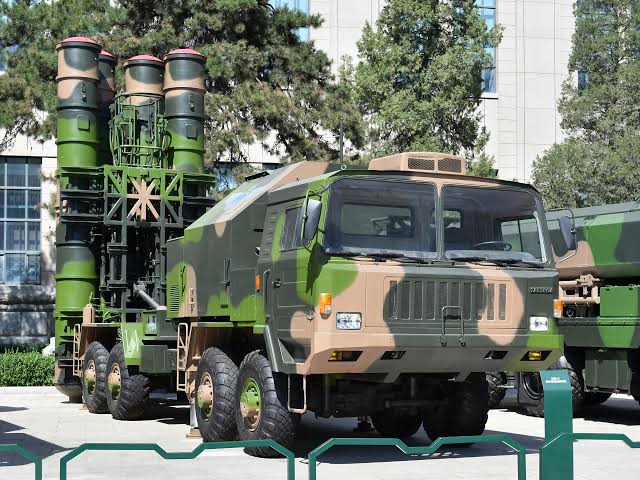
Looks similar to HQ-16, but still different. HQ-9 serves the role of long range interception of airborne targets. The latest HQ-9B is said to be equipped with semi-active radar homing and infrared homing missiles. 300km detection range with the a phased array radar.


WHO OWNS THE TECHNICAL SUPERIORITY?


When we talk about fighter jet strength, it is clear that People Liberation Army Air Force is ahead in terms of both quantity and quality. The only Air Force that operates a 5th generation aircraft and successfully operationalised more that 400 units of indigenous fighters is surely better in terms of flying state-of-the-art battle machines. The Indian Su-30MKI may give a tough competition to J-10 and Su-30MKK fighters. Both Su-30MKI and Su-30MKK are derived from Su-30,however, Su-30MKI has better manverability and a tougher than Su-30MKK in close combat scenario. But BVR combat is more common these days, because of highly sophisticated medium to long range missiles. Therefore, Su-30MKI may not be the first one to shoot. Electronic Warfare J-16D is something that is more concerning for Indian defence. The aircraft can effectively conduct the Supression of Enemy Air Defences (SEAD) mission and pose a serious threat to ground elements. It doesn't mean that Indian air force is not well trained or weak, but the thing here is that China use better.

As I already said that AWACS is a must for modern air forces, it is clear that the capability and role of the airborne radars matters a lot in real life missions. China is ahead in terms of quantity, but I believe that it is a tie. There is a major difference between the airspace of India and area of China. China has a bigger area to cover while India has comparatively smaller area to cover. One Phalcon to monitor northern front and one Phalcon to monitor North eastern front can do the job comfortably. Not to forget that AWACS are vulnerable to enemy missiles, it creates a high risk if it is flies close to the border. Therefore, an AWACS with 400km radar range can manage to precisely monitor the airspace as well as stay outside the enemy missile range. The PL-21 ultra long range missiles are still in development and it is not clear whether it is deployed on any Chinese fighter aircraft or not.


Coming to Air Defence systems, the China has a clear range advantage. The HQ-16 and HQ-9 SAM systems are said to be advanced than Russian Pantsir and S-300 systems and hence, India cannot take it lightly. However, in quality terms, India is little ahead as it operates Israeli equipment, the SPYDER and MR-SAM are state-of-the-art equipments with assurance of Israeli technology that is highly sophisticated when it comes to proving the capability in real world.


A LOOK ON ACCESSIBILITY 

Technical superiority is only one of the factors used to define capability of any side. Owning good assets is not the only way to win a war, an effective utilisation of those assets matter the most. In other words, how the assets can be accessed according to requirements. In this section, we are going to look after factors that effects the conflict:-

Terrain

The terrain plays an important role in defining which side is in dominant position. Ladakh is a high altitude cold desert region, with a lot of high mountain ranges. In such terrain, buildup of airstrips is not as open as other regions. With high altitude, there are many problem arises. The logistics, supplies are usually harder as compared to other regions. Eg, a helicopter with low service ceiling cannot fulfill the role of supplying essential equipments in such hilly region, however, the helicopter may work effectively in desert or plain terrains. This is the reason why India and China always equip themselves with weapons that can work in all weather conditions. The HAL Light combat Helicopter (LCH), is the only attack helicopter in the world that is capable of reaching the altitude upto 21,000 ft.

Deployment


You may own a high number of fighter aircrafts, but can you place each and every jet at the border? Answer is No! China shares the border with 13 countries other than India and the total land area is somewhere around 9.5 million sq. kilometres, whereas the area controlled by India is somewhere around 3.3 million sq. kilometres. Thereforere, the concentration of Indian airbases in a region is more than the concentration of Chinese airbases. According to details available in public domain, the no. of Chinese airbases near Indo-China border is comparatively less than Indian airbases. 

Su-30MKI at Leh, just 250km away from China border

With more air bases, the Indian Air Force can manage quick launch of fighter aircrafts as a support or interceptor package.


Experience


Well, here, India owns a serious advantage. The last major war fought by China and the army was Sino-Vietnamese war in 1979. Unfortunately, China lost the war and 30,000 troops. The main reason for the defeat was the experience of Vietnamese troops, who fought valiantly against US troops just 4 year ago and achieved victory. Hence, this war proved how experience is necessary tp fight any war. India already fought 4 wars against its arch rival Pakistan and even 2 wars with China. The first war with China was in 1962, where they defeated the Indian troops and captured a large territory of the then Jammu & Kashmir province of India. In 1967, just two years after a major Indo-Pak war, China again attacked India to capture Sikkim, however, it didn't work according to plan and China failed to achieve their objective because of Indian retaliation. 

Coming to India, the last major war occured in 1999 when India retaliated against capture of Kargil. The Army and Air Force worked jointly and recaprured their position. In 2019, India was also involved in two day skirmish against Pakistan (outcomes are still unclear) and utilised important assets like the Phalcon and Netra AWACS, Mirage 2000 aircraft, etc in real mission against the enemy. Therefore, India is much more experienced in battle than the Chinese troops.


Allies

The reason why alliances are formed is to support the country in good as well as bad times. With regional ally Pakistan, China can engage India on two fronts and cause heavy pressure on the Indian command. India (looking at the current political situation) lack a trustworthy ally in the region. However, Taiwan is an option to form an alliance against China. Taiwan is an island nation,situation close to Chinese mainland. Chinese administration has some serious issues with Taiwan and very recently, General Li Zuocheng, Chief of the Joint Staff Department of the PLA Central Military Commission, threatened to attack Taiwan once it's necessary. You can find a detailed report on Sydney Morning Herald news portal.

Taiwan holds a capable military power. It receives milotary assistance and supplies from USA and operates the state-of-the-art F-16 "Falcon" fighter aircraft and recently acquired the latest AESA equipped F-16V variants. With the support of Taiwan, India has a chance to gain support during the military conflict.
Taiwan Air Force F-16 "Falcon"
Photo courtesy:- Zian Kia Zhou
The role of USA is uncertain, but it is clear that it will participate through any way possible. Maybe only as a mediator or an ally of India for military support.

WHY NO NUKES? 

There is no doubt that the Weapons of Mass Destruction (WMD) is highly concentrated in the region. Both India and China own nuclear weapons. But the thing here is that both are the only two nations in the world to adopt the "No First Use" policy. It means that country will never use its nuclear weapon to carry out the first strike on the enemy, but only to retaliate against adversary's nuclear strike. 

With both nations adopting this policy, it is highly evident that nuclear war has low possibility, but only if both nations stick with the policy because sometimes, rules are broken in a war.


END NOTE

Now with the end of this article, I would like to say that this article also consists my personal opinions too and opinions vary person to person. I agree that war never brings peace, it always bring chaos, destruction and regret. But as a page dedicated to write on topics related to defence and strategic matters, it is our duty to present you information on the topic. I hope both governments solve this issue with proper dialogue and war may not erupt. 

"War doesn't determine who is right-only who is left"
~Bertrand Russell 

And finally, thank you everyone who read it till the end. I am highly delighted that you supported our page. If you want, you can share the article with your friends and in case if youdare not a follower of our page, then click here and be one of our worthy supporter:-


References:-

https://www.thequint.com/news/india/india-china-faceoff-in-sikkim-small-indian-lt-who-punched-a-big-chinese-major

https://en.m.wikipedia.org/wiki/List_of_active_Indian_military_aircraft

https://en.m.wikipedia.org/wiki/People%27s_Liberation_Army_Air_Force

https://missiledefenseadvocacy.org/missile-threat-and-proliferation/todays-missile-threat/china-anti-access-area-denial-coming-soon/hq-16/

https://missiledefenseadvocacy.org/missile-threat-and-proliferation/todays-missile-threat/china-anti-access-area-denial-coming-soon/hq-12/

https://missiledefenseadvocacy.org/missile-threat-and-proliferation/todays-missile-threat/china-anti-access-area-denial-coming-soon/hq-9/

https://www.popularmechanics.com/military/navy-ships/a25322576/is-the-chinese-military-ready-for-war/

https://www.timesnownews.com/columns/article/china-s-war-preparedness-against-india-a-comparison-of-military-and-air-power/474625

https://www.cfr.org/backgrounder/no-first-use-and-nuclear-weapons